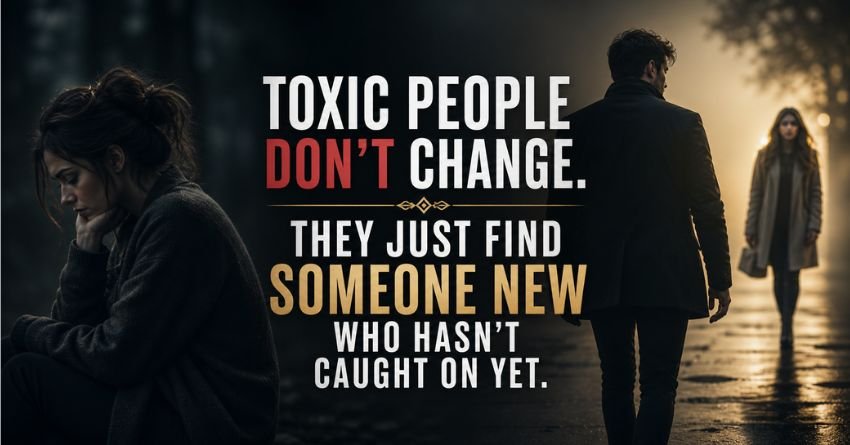
There’s a lie we tell ourselves when we finally walk away from a toxic person.
First, we tell ourselves they’ll learn. Then, we hope that losing us will be the wake-up call. Eventually, we imagine they’ll sit alone with their thoughts and finally understand the damage they caused.
However, here’s the brutal truth nobody wants to hear: toxic people don’t change. Instead, they just find someone new who hasn’t caught on yet.
As a result, once you understand this, everything about your past starts to make sense — every confusing conversation, every gaslight, every sudden charm offensive.
Why Toxic People Don’t Change (Even When They Promise To)
In short, real change requires three things: self-awareness, accountability, and discomfort.
Unfortunately, toxic people avoid all three like fire.
For example, self-awareness means looking inward and seeing yourself clearly — including the ugly parts. However, toxic people can’t do this because their entire identity is built on the illusion that they are the victim. Always. In every story.
Similarly, accountability means saying “I did that, and it was wrong” — full stop, no excuses, no “but you made me.” Yet toxic people physically cannot say these words without adding qualifiers that shift the blame back to you.
In addition, real change is painful. It means sitting with shame, guilt, and the realization that you’ve hurt people who loved you. Furthermore, toxic people would rather burn down ten relationships than feel that pain for ten minutes.
So instead of changing, they do something much easier: they find a new audience.

The Replacement Cycle: How Toxic People Move On
If you’ve ever been blindsided by how quickly your toxic ex, friend, or family member moved on, you’re not alone. In fact, there’s a clear pattern, and once you see it, you can’t unsee it.
Stage 1: The “New Me” Performance
Right after you leave, the toxic person reinvents themselves — at least on the surface. For instance, you’ll see new profile pictures, new hobbies, new friends, and new language about “growth” and “healing.”
On the surface, it looks like change. In reality, it isn’t.
Instead, it’s marketing.
In other words, they’re not becoming a better person. Rather, they’re rebranding to attract their next supply.
Stage 2: Love Bombing the New Person
Soon after, the new person in their life gets the same treatment you got at the beginning.
For example, expect constant attention, grand gestures, and lines like “I’ve never felt this way before,” “You’re different,” and “You understand me like nobody else.”
If you’re watching from the outside, it’s surreal. Suddenly, you remember those exact words. Then, you remember that exact look. Finally, you remember being told you were the one.
But you weren’t. Truthfully, you were just the previous role in a script they keep recasting.
Stage 3: The Smear Campaign
Next, this is where it gets ugly.
To explain why the relationship with you ended, the toxic person needs a story. Moreover, in that story, you have to be the villain. Otherwise, the new person might start asking uncomfortable questions like, “Wait, why did you and your ex really break up?”
So they tell lies. Some are small ones. Others are big ones. Sometimes, they tell ones that completely rewrite history.
For instance, they might tell their new partner you were jealous, controlling, unstable, or even abusive — whatever inoculates them against the truth. Naturally, the new person believes it, because they’re still in the love-bombing stage and would believe almost anything.
Stage 4: The New Person Catches On
Eventually, this is the part toxic people can’t control, no matter how hard they try.
Sooner or later — six months, two years, a decade — the new person starts noticing the same patterns you noticed. For example, they spot the little lies. Then, they feel the sudden coldness. Soon, they realize how every argument somehow becomes their fault. Finally, they watch their friends slowly disappear.
As a result, they start asking the same questions you once asked.
That’s when the cycle starts again. New target. New story. Another round of “I’ve never been this happy before.”

Why It Feels So Personal (But Isn’t)
Without a doubt, one of the cruelest parts of being discarded by a toxic person is how easily they seem to replace you.
For years, you tried to be enough. Meanwhile, they spent six weeks finding someone new and acting like you never existed.
However, here’s what most people don’t realize: it was never about you.
In fact, toxic people don’t bond with humans the way healthy people do. Instead, they bond with roles. For example, they needed someone to fill the role of “partner” or “best friend” or “loyal sibling who never says no” — and you happened to fit the audition.
When you stopped performing the role the way they wanted, they didn’t grieve you. Rather, they held auditions.
In conclusion, that’s not a reflection of your worth. Instead, it’s a reflection of their incapacity for real connection.
The Signs You’re Watching a Toxic Person Recycle Their Behavior
If you’re still in contact with a toxic person — through mutual friends, social media, or shared family — you’ll see the patterns play out from a distance. Therefore, watch for these signs:
1. They publicly announce their “transformation.” Generally, healthy people who are genuinely changing rarely talk about it. Instead, they just live differently. By contrast, toxic people post about it. Loudly. Constantly.
2. The new partner looks suspiciously like a younger, more naive version of you. Specifically, you’ll notice the same general type, the same vulnerabilities, and the same desperate hope to be loved.
3. Their stories about you keep changing. Last year, you were “crazy.” This year, you were “abusive.” Next year, who knows. Basically, the story shifts to fit whoever they’re trying to convince.
4. People you trusted start treating you differently. Unfortunately, that’s the smear campaign working. However, don’t try to fight it. In time, the truth will reveal itself.
5. The new person starts reaching out to you. Eventually, it always happens — sometimes years later. Usually, they want to compare notes. Often, they want to know if it was real. By then, you’ll already know what they’re going to say before they say it.

What to Do When You Realize They’ll Never Change
Honestly, acceptance is the hardest part — and the most freeing.
Once you stop waiting for the toxic person in your life to change, something shifts inside you. Suddenly, you stop checking their social media. Then, you stop wondering if they think about you. Finally, you stop hoping for the apology that will never come.
Instead, you start living again.
Here’s what that looks like in practice:
First, stop looking for closure from them. Realistically, they cannot give you what they don’t possess. Therefore, closure has to come from within — from your own decision that the chapter is over.
Second, stop explaining yourself to people who believed the lies. Honestly, if someone took the toxic person’s word over yours without ever asking your side, they were never really in your corner to begin with. So, let them go.
Third, start documenting reality for yourself. Practically speaking, keep a private list of things that actually happened. Otherwise, memory is fragile, and toxic people are experts at making you doubt your own experiences. As a result, writing it down protects the truth.
Finally, build the life they said you couldn’t have. Truthfully, nothing infuriates a toxic person more than watching you thrive without them. Not because they want you back — but because your happiness exposes the lie that you were the problem.
The Hardest Truth of All
Right now, somewhere out there, the person who hurt you is sitting across from someone new.
Currently, they’re saying the same words. Right now, they’re making the same promises. Today, they’re wearing the same mask.
Meanwhile, that new person is staring at them the way you once did — full of hope, full of trust, full of love.
Sadly, you can’t warn them. Even if you tried, they wouldn’t believe you. After all, they have to learn the same way you did.
But here’s the gift in all of this: you already know. Already, you paid that tuition. Already, you learned that lesson.
Most importantly, you’re not the one who’s about to find out.
Rather, you’re the one who already woke up.
In the end, that — not their apology, not their downfall, not their replacement finally catching on — is the real victory.
Final Thoughts
Ultimately, toxic people don’t change because they don’t want to. Above all, change requires the kind of pain they’ve spent their entire lives running from.
So, they keep running. Into new relationships. New friend groups. New jobs. New cities. Sadly, new victims.
However, every single one of them eventually wakes up — just like you did.
Truthfully, you’re not bitter for understanding this. Likewise, you’re not cold for accepting it. Furthermore, you’re not unhealed for finally seeing the truth.
Instead, you’re free.
In the end, freedom is something a toxic person will never have, no matter how many people they replace you with.
If this article resonated with you, share it with someone who needs to read it. Sometimes, the most healing thing we can do is help another person stop waiting for an apology that’s never coming.