For a long time, a father failed to notice that his seven-year-old daughter, Sophie, was slowly changing. Once a cheerful little girl who ran into his arms every evening, she had suddenly become quiet and withdrawn. She stopped laughing at the dinner table, no longer asked for bedtime stories, and almost seemed to avoid looking him in the eyes.
At first, he thought it was simply exhaustion from school or the usual mood changes children go through. His wife, Laura, always had an explanation for everything. She would say that Sophie was just sensitive, that she was looking for attention, or that she needed more discipline.
And he believed her.
Today, he says that is what hurts him the most.
Because while he trusted the explanations of the adult beside him, his little girl was slowly sinking into fear inside her own home.
Everything changed one night when he woke up shortly after midnight. The sound of running water pulled him from his sleep. He reached toward the other side of the bed and realized Laura wasn’t there.
The door to Sophie’s room was open, but her bed was empty.

The hallway was dark, and the only light came from the bathroom, where the door had been left slightly open.
As he approached barefoot, he could feel his heart pounding so hard that he could barely breathe.
Then he heard Laura’s voice.
Quiet.
Cold.
Almost calm.
“Good… stay quiet.”
At that moment, he froze.
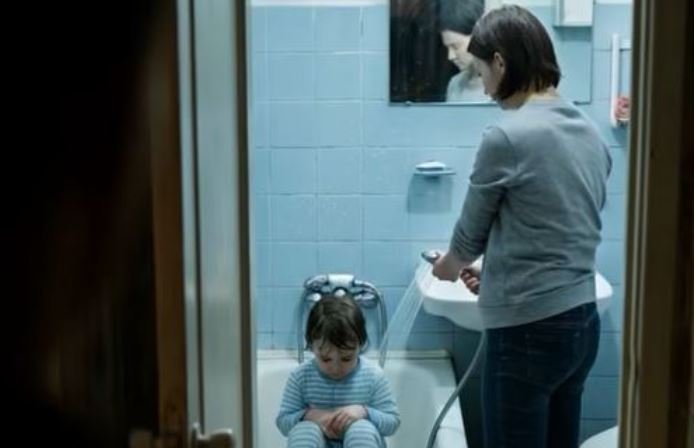
Through the small opening in the door, he saw something he would never forget. Sophie was sitting in the bathtub fully dressed, her wet pajamas clinging to her body. Her hair was soaked, and her small hands were tightly clenched in her lap as if she were trying to hide her trembling.
Laura stood beside her, holding the showerhead. The water wasn’t spraying directly onto the girl, but it was close enough to make Sophie flinch every time.
For the first time, the father clearly saw what he had refused to understand for months.
His daughter wasn’t simply sad.
She was afraid.
Then Laura stepped closer and whispered something that made his blood run cold:
“If Daddy asks, you’ll tell him you spilled juice on yourself.”
At that moment, he felt as though his entire world were collapsing.
Suddenly, all the little things took on a new meaning. The way Sophie stared at the floor. The way she flinched whenever Laura said her name. The silence that seemed to grow with each passing day.
He wanted to storm into the bathroom immediately, shout, and protect his child.
But then Sophie looked up and saw him through the narrow opening in the door.
Her lips trembled, but she said nothing.
And in that silence, he understood something no child should ever have to feel.
She was begging him not to make things worse.
So he remained hidden until Laura turned off the water and quietly said:
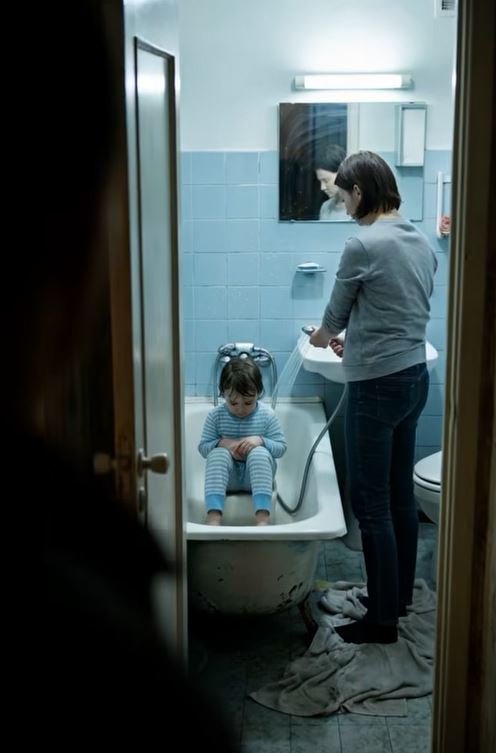
“Remember… this never happened.”
When his wife left the bathroom, she walked calmly down the hallway as though nothing terrible had happened.
It was that cold calmness that frightened him the most.
A few minutes later, he entered the bathroom.
Sophie was still sitting in the bathtub.
Wet.
Silent.
A little girl who no longer knew what safety felt like.
When he softly called her name, she looked at him and said the words that broke his heart:
“Daddy… please don’t be angry.”
He immediately knelt beside her and tried to keep his voice steady.
He told her he wasn’t angry with her and never would be.
Through her tears, Sophie admitted that Laura had been telling her that she was a burden to him and that one day he would leave her if she ever told him what was happening.
Those words completely shattered him as a father.
He took a towel, wrapped his daughter in it, and carried her to her bedroom. She clung to his neck as though she were afraid he would disappear the moment he put her down.
That night, he didn’t confront his wife immediately.
He sat beside Sophie’s bed until she fell asleep. Then he returned to the bathroom, trying to understand how long this had been going on.
That was when he found a small sketchbook hidden beside the laundry basket.
Its pages were wet and wrinkled.
The first drawings showed an ordinary family — a house, the sun, and two parents holding their child’s hand.
But the later drawings had changed.
They showed a little girl in a bathtub.
A woman standing beside her.
And a man behind a closed door.
Under one of the drawings, Sophie had written in shaky, childlike letters:
“Daddy didn’t hear me.”
The father sat down on the bathroom floor and cried harder than he ever had in his life.
Not quietly.
Not trying to appear strong.
He cried because his daughter had been living in fear for months while he believed everything was fine.
The next morning, he called his sister, then a child therapist, and began packing Sophie’s belongings while Laura was still asleep.
When Laura saw the suitcase, she began shouting and insisting that the child was exaggerating.
But then something happened that finally opened his eyes completely.
Sophie hid behind him.
Like a child trying to escape from someone she was afraid of.
And for the first time, he decided he would no longer listen to the adult who always had an explanation for everything.
He would listen to his own child, who had been silently asking for help for months.
He looked at Laura and calmly said:
“You will never teach my daughter to be afraid of silence again.”
They left that same morning.
Recovery wasn’t quick or easy.
Sophie didn’t return to her old self overnight.
She would still flinch whenever she heard running water. She would ask whether the doors were locked and wake up in the middle of the night to check whether her father was still there.
And every time, he gave her the same answer:
“I’m here. I’m not going anywhere.”
Several weeks later, during therapy, Sophie drew another picture.
This time, the bathroom door was open.
Her father was sitting beside her, holding her hand.
Underneath the picture, she wrote:
“Daddy heard me.”
Her father put that drawing in a frame — not because it made him proud, but because it reminded him of how close he had come to being too late.
This story carries an important message that many parents forget.
When a child becomes quiet, it isn’t always just a phase.
When a child stops laughing, it isn’t always an ordinary change in mood.
Sometimes, silence is the loudest cry for help a child knows how to make.